

Introduction
Giga-projects are no longer just about skyline statements or infrastructure scale.
They are now the centrepiece of national transformation strategies — instruments to reshape economies, societies, and futures.
Since Saudi Arabia’s Vision 2030 announcement, these multi-decade, multi-billion-dollar undertakings have redefined the role of real estate, from a sector to a system of national consequence.

Aspirations
Giga-Projects deploy various forms of real estate—land, buildings, infrastructure, and place—as the preferred mechanism to realise national goals. For example, the presence of residential assets ensures a liveability-focused project providing vital housing. Similarly, the presence of various industries aims to generate economic activity, leading to job creation.
Behind the branding, governments pursue giga-projects for three reasons.
Economic Diversification & Growth. They act as conduits to grow the economy by investing in untapped sectors, such as tourism, advanced manufacturing, and tech.
Social Cohesion and Reinforcement. They create spaces where culture, heritage, and identity are expressed and reinforced. It is a cultural legacy built through intentional placemaking, not inherited by accident.
Anchoring the Future. They anchor a vision of the future in the present, creating positivity and bringing the possibilities of tomorrow today. The Diriyah Project in Riyadh (Saudi Arabia) is a perfect example.
Fundamentally, every giga-project is a scaled real-estate system reflecting and executing national goals. Understanding how that system works — and who drives it — is what separates projects that deliver from those that drift.
Giga Project Domain Navigation
Giga-projects engage with real estate as an interplay of multiple industries — construction, finance, urban planning, property operations, regulation and more. Each brings its own objectives, capabilities, and power dynamics, forming a domain unique in its scale, complexity, and national importance. They must reconcile public sector vision with private sector execution. They must navigate land use constraints, attract investment, enable infrastructure, and shape socio-economic outcomes — all at an extraordinary scale and within rigid timelines. In this reframing, real estate is more than just about buildings, but about:
Managing and controlling the sovereign land bank
Deploying capital across an ultra-long time horizon (10-20+ years)
Developing an ecosystem of public-private partners for outcome realisation
Evolving operating models from development to long-term asset management
Harmonising multi-product and multi-assets in the existing urban fabric
Infusing culture, heritage, and purpose through place-based narratives, reinforcing national identity
This domain can be navigated by creating a 2x2 map based on two dimensions:
Financial Orientation: Is the player profit-driven or service-oriented
Ownership: Is the player government-owned or private?
This yields four broad types of entities:
Public–Service Oriented (e.g., municipalities)
Public–Profit Oriented (e.g., sovereign wealth funds)
Private–Profit Oriented (e.g., developers, contractors)
Private–Service Oriented (e.g., non-profits or NGOs, less common in giga-projects)
This simple matrix helps identify where a given entity sits in the broader ecosystem and what motivates its behaviour.
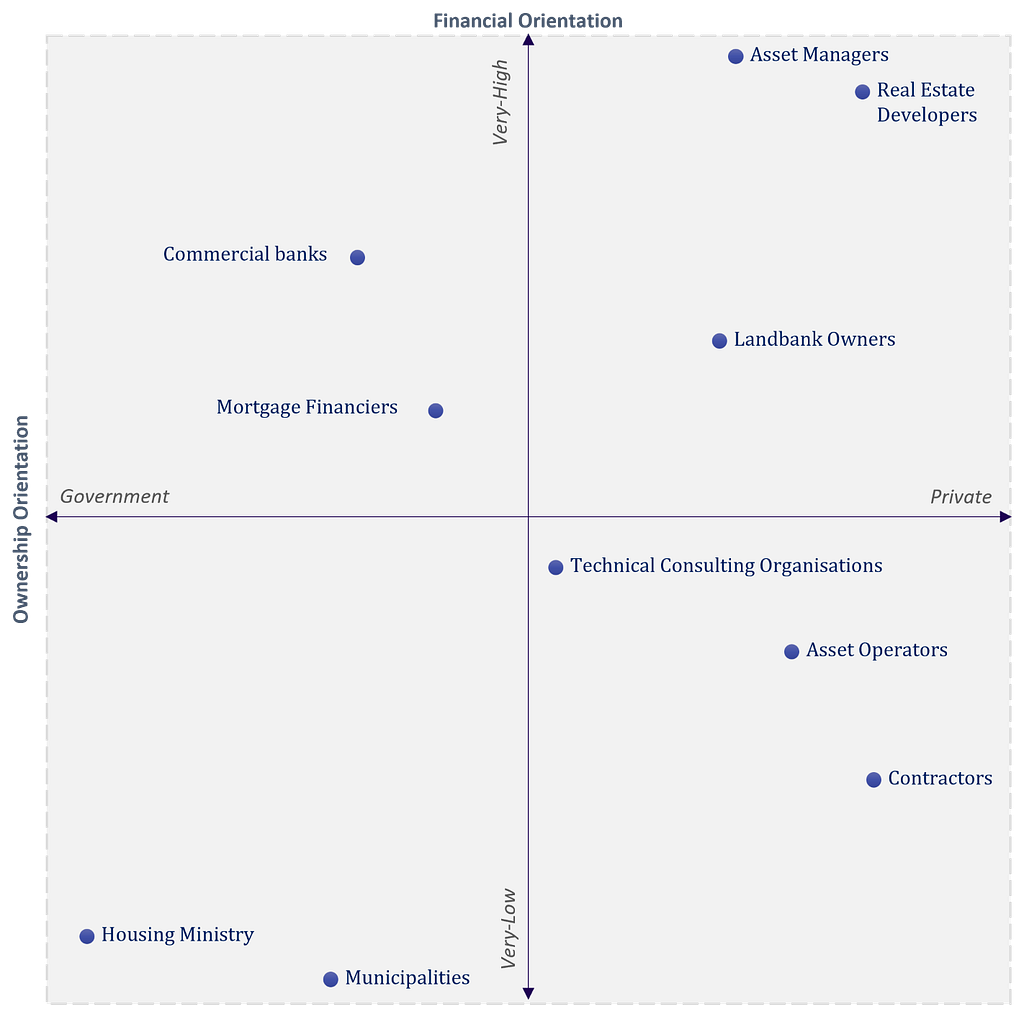
Each player operates with its internal logic:
Developers want to deliver on time and on budget.
Municipalities want compliance and long-term livability.
Banks seek creditworthy projects with clear exit strategies.
Contractors want scope clarity and predictable payments.
Landowners want asset appreciation and/or utilisation.
These diverging motivations often result in discontinuity — strategic misalignment, scope creep, and reactive problem-solving. In giga-projects, such misalignments can lead to delays, cost overruns, or reputational damage on an international stage. For example, a developer may commit to a launch date driven by political optics, while financing partners are still conducting due diligence. Or a municipality might revise infrastructure requirements mid-project, forcing redesigns. These tensions are not dysfunctions — they are intrinsic to the domain.
Central Player for Giga-Projects: Developer or Asset Manager
Who is the gravitational centre of a giga-project? In early phases, it’s the developer setting the tone for land use, partners, and phasing. However, over time, the developer may evolve into an Asset Manager. This requires a transformation of their operating model, which I intend to cover in a later piece. Alternatively, an existing Asset Manager may be appointed with the long-term focus of optimising yields, performance, and sustainability.
Giga-Projects as Real Estate Playbooks in Disguise
When you look past the branding and vision decks, giga-projects are essentially trying to answer three real estate questions at scale:
How do we build new economic sectors aligned with national strategy, utilising giga-projects and real estate as enablers?
How can giga-projects act as places of community cohesion, reinforcing cultural values and national identity?
How do we ensure real-estate in giga-projects delivers sustainable financial returns to investors?
These are not new questions. But their scale, speed, and strategic gravity in giga-projects require an entirely new playbook. The articles that follow examine each dimension in turn — from strategic design and value chains, to capital structuring, site constraints, and the long-term outcomes that will determine whether these projects deliver on their national promise.