

Introduction
Giga-projects are a new real estate category underpinned by traditional and new asset classes that are interconnected in the service of national strategic objectives. At times, and wrongfully, they are categorised under “urban regeneration”, and I disagree with such a categorisation. While they transform the surrounding urban landscape, they embody the sovereign ambitions to achieve national objectives. The latter separates them from mainstream urban regeneration projects. Giga-projects are their own category and orchestrate different entities, as illustrated in my last article (link), and the central challenge is delivering them with coherence.
Challenge
A key challenge in Giga-Projects is translating the vision into reality--that is, what was envisioned is executed. It is inevitable for such projects to drift under the weight of execution. The short-term focus on delivery milestones starts to dilute the vision, creating a sense of disconnect, and in the absence of a coherent framework, tactical activities satisfy short-term requirements but expose the long-term. This article focuses on a framework of strategic components that must exist for giga-projects to be successful, built from my direct experience with such projects.

Framework
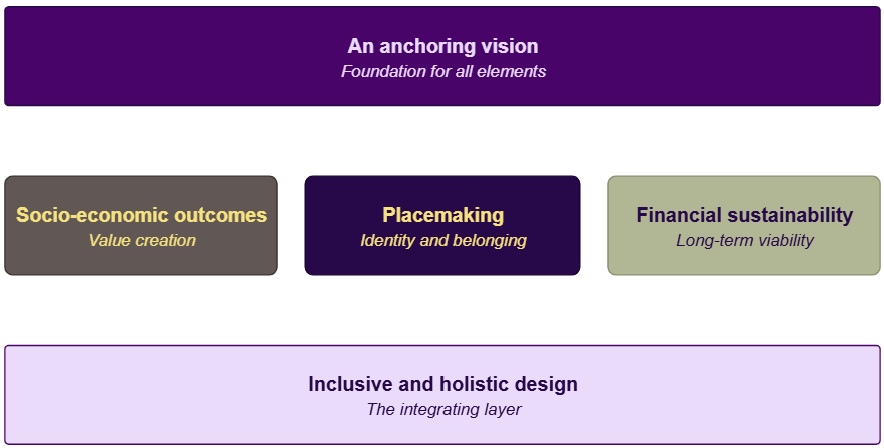
The framework has 5 elements that, working together, ensure better outcomes.
An Anchoring Vision--What future are we trying to create?
Socio-economic Outcomes--Will it provide benefits in the future?
Placemaking--Are our traditions, culture, and beliefs embedded in this future?
Financial Sustainability--How can this be a net-positive contributor?
Inclusive and holistic design--Does our design incorporate the above?
A diagrammatic outline is shown below.
An Anchoring Vision
Giga-Projects have ambitious, expressive, and futuristic visions, and considerable effort goes into articulating the desired end state. It is extremely difficult, however, to find any interim visions describing the project 5, 10, or 15 years after its announcement, even a simple description of the state of the infrastructure. Such descriptions need to exist as the vision acts as a common banner for action. As different organisations develop their execution plans, the presence of such defined states minimises the risk of vision dilution. The short-term focus disconnects the organisations from the long-term vision, which can lead to sub-optimal outcomes.
For example, a smart city powered by AI and the latest cutting-edge technology requires a larger ecosystem that provides access to talent, device manufacturing, and strong connectivity infrastructure, among other things. An organisation developing such a strategy will focus on delivering on its own workstream without accounting for the broader ecosystem dependencies. The question should be seen as a reflection rather than a constraint, as enabling systems may require substantial improvement before a vision is realised.
Socio-economic Outcomes
Socio-economic outcomes such as GDP contribution, job creation, new economic sectors, regional development, home ownership, skills development, and others are the second element of the Giga-project strategy. The orientation of these metrics reveals the underlying priorities. For example, if home ownership is key, vision documents and relevant Giga-Project corporate documents will explicitly mention pre and post-states.
Most Giga-projects have detailed metrics on the attained socio-economic outcomes at the time of the vision, but are drowned under the weight of execution pressure. Missed milestones generate more debate than slipping socio-economic targets. The former are visible and measurable; the latter drift quietly, unnoticed until the damage is done.
Countering such behaviours requires continuously anchoring decisions in socio-economic outcomes beside financial metrics. Otherwise, the Giga-Project distils to a construction project doing a great disservice to the national strategy of economic transformation.
One approach is to assign weights to financial and socio-economic metrics, with decisions made on the overall score. Such analysis can operate across multiple scales: giga-project master plan, phase, district, and asset-level. Each unit contributes to the overall socio-economic metrics. At higher levels of aggregation, the link between outcome and contribution is direct—that is, the completion of a master plan drives job growth. Similarly, at lower levels the link shifts to indirect as they contribute to an overall objective such as job growth.
Placemaking
A critical aspect for giga-projects is providing “meaning” to a place, that is, giving people a reason to belong to it. It requires a thorough understanding of the local culture, heritage, and values of its people. Imported foreign values can provide an initial momentum to the project, but a place lasts when it is grounded in local customs.
Giga-projects should act as amplifiers, and not substitutes, by preserving the authenticity of the local culture and heritage. Creating a place, however, requires time and curation. A project has a defined start and end, but a place endures over time. The Pyramids, Colosseum, and Eiffel Tower are examples of a giga-project becoming a place. In London, the regeneration around Kings Cross has added another place with meaning. While predominantly residential, the anchoring of retail and restaurants around the historic coal yard gives meaning to the place.
Coal was an energy source powering the city, and today, the restaurants, retail, and major office occupiers are powering the area.
For Giga-Projects to endure, they must embed placemaking principles throughout their project lifecycle, creating a lasting connection with their people.
Financial Sustainability
Arguably, financial sustainability is the most discussed aspect of Giga-Projects, and their impact is reduced to a handful of financial metrics such as total spend (often in billions of dollars), IRRs (Internal Rate of Return), or Return on Equity (ROE). We have already argued for broadening the definition of financial sustainability. The focal challenge for Giga-Projects lies in the underlying assumptions. With limited public information, it is difficult to determine the expected return requirements from such projects.
If we assume, however, they would have typical return requirements (i.e. IRRs of >12%), the underlying financial models are developed to support the return expectations, whereas future market conditions may not support those expectations. The result: spiralling budgets, delayed completion timelines, and other issues lead to a comprehensive project rationalisation and prioritisation, with some being entirely cancelled. The long time horizons necessitate continuous updates to financial projections, grounding Giga-Projects in market realities. The reliance on outdated financial models and investment cases should be challenged the moment the first shovel breaks ground.
Assumptions are one side of the financial equation: strong product-market fit is the other. We define product-market fit as strong alignment between the end-product and market requirements, evidenced by the willingness of external capital to participate. We have seen, generally, that Giga-Projects demonstrate strong product-market fit driven by underlying national priorities. Large-scale urban regeneration projects in the UK, which I consider Giga-Projects, cater to the residential and office demand, strongly aligned with investor expectations. Saudi Giga-Projects, similarly, are driven by economic transformation resulting in expansion and creation of new economic sectors, and their product-market fit remains to be fully tested.
Giga-Projects require continuously updated information to assess their sustainability and create strong alignment between their offering and market expectations.
In the absence of such steps, Giga-Projects will be considered failed experiments.
Inclusive & Holistic Design
Design is a critical component in giga-projects, and it is broader than its architectural definition. It is a crucial mechanism through which all components are integrated harmoniously. Such designs also reflect the orientation of the Giga-Project.
For example, Giga-Projects inclined toward financial results will require designs maximising revenue-generating spaces to achieve the targeted returns. Conversely, socially focused projects will dedicate space to culture, heritage or other types of spaces.
In our view, design acts as the final gate, ensuring socio-economic outcomes, financial sustainability, and placemaking elements are aligned to the underlying vision. After which, design should focus on its architectural spirit to reflect all three elements. Designs, unfortunately, often remain within the architectural realm, creating disconnects between idealism and reality. Design requires a multi-faceted view (social, economic, sustainable, financial, and others) to create a successful giga-project. It should be led by those responsible for delivering the Giga-Project, ensuring the design brief is accountable to all five elements before a single line is drawn.
Concluding thoughts
These five components form an integrative framework to create a balanced giga-project. Overlooking any of these components creates the risk of misalignment, cost overruns, and poor outcomes for stakeholders. Successful giga-projects must embody vision, embed value, and endure over time. They should be constantly assessed against this framework to minimise drift.