

Giga-Projects are routinely treated as large-scale real estate development, and their value is gauged from that perspective. In fact, they are not.
Giga-Projects are an aggregation of three distinct value chains: Investment, Development, and Asset Management, each operating on different principles, operating frameworks, and measures of success. This article explores the tension caused by such aggregation under a single controlling structure, and as the Giga-Project progresses, certain portions of the value chain push and pull the overall direction of the project.

Understanding the Three Value Chains
Each chain operates on a distinct logic, and understanding that distinction makes the tensions that follow legible.

Each chain creates value differently:
Investment focuses on raising the required capital through appropriate structures such as direct equity-based investments, debt structures, revenue-sharing agreements, joint-development partnerships, BOT/BOOT structures, and others. In publicly funded projects, the primary objective is often to minimise public equity injections.
Development focuses on transforming raw land into the desired vision captured within the master plan, underpinned by placemaking and community enrichment principles.
Asset Management focuses on optimising performance while preserving long-term capital and social asset value.
Each value chain reveals nuances missed at the surface, and in pursuit of the common goal, the chains create internal frictions. The image below shows prototypical sub-value chains within giga-projects built from my experience working on such projects.
Each project fine-tunes the sub-value chain to meet its immediate requirements.
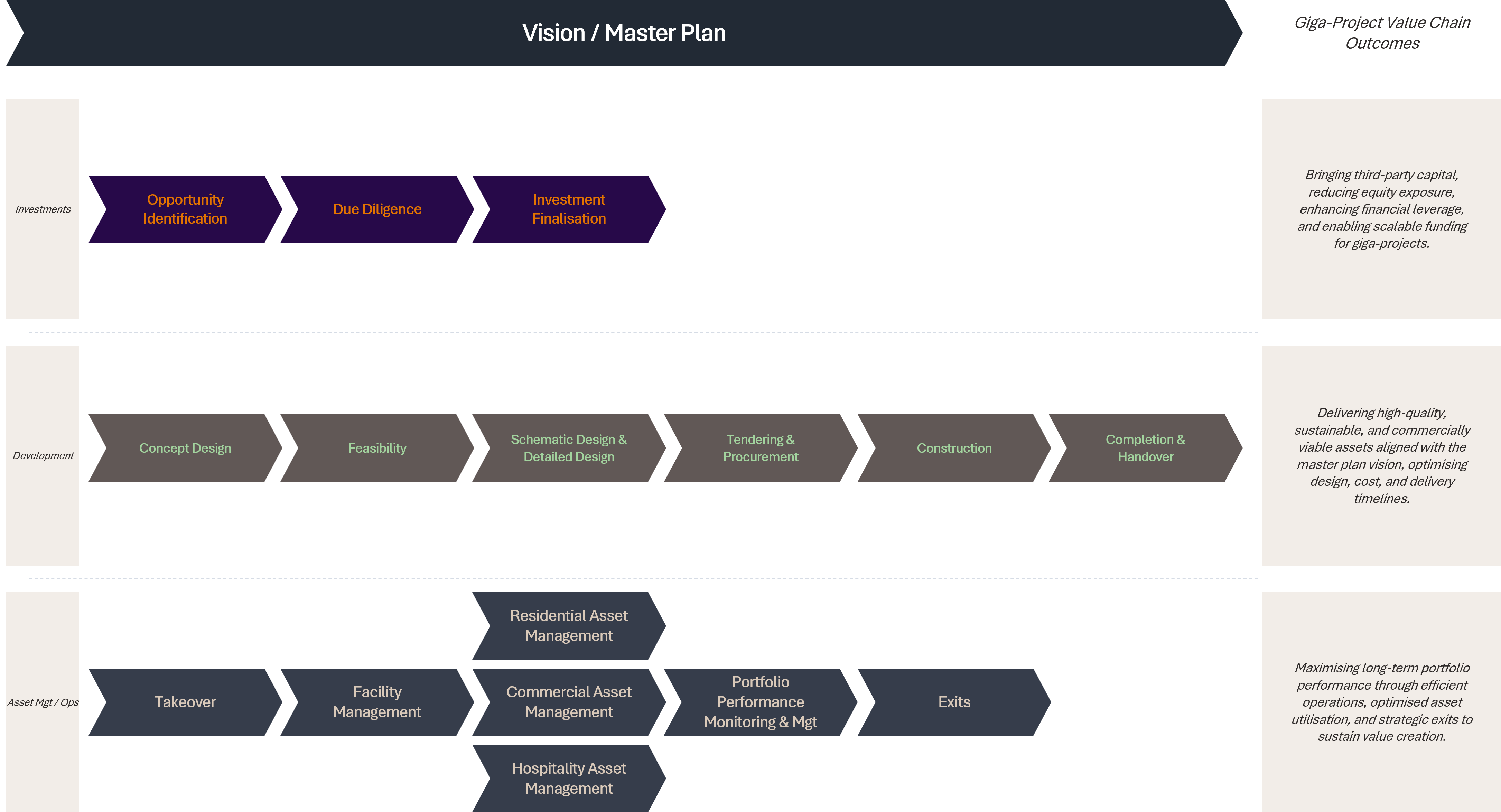
The responsibility for asset exits may lie with either the investments or the asset management team, depending on the organisational context. In the illustration above, I’ve assigned this function to the asset management team, as it fits with the overall evolution of Giga-Projects as they transition from development to perpetual operations. While investment teams may also be involved in certain cases, I’ve limited their scope here to capital raising and portfolio management.
Misalignments Across Value Chains
Naturally, giga-projects focus heavily on developments, as the initial phase converts raw land to a built environment, and through it, a vision becomes a reality. Yet, the intersection of these sub–value chains is rarely seamless; each operates with its own drivers, creating areas of tension and misalignment. I highlight such misalignments with two examples below:
Example 1 — In practice, development teams often prioritise on-time completion.
Once funding is secured, they move ahead with construction plans to break ground.
Execution is the first core activity in realising the vision. In pursuit of achieving timely completion, development teams may operate almost entirely independently with limited coordination across investment or asset management teams. The misalignment ripples across the commercial outcomes of the other value chains.
For example, development teams will construct assets without exploring options such as capital raising, joint-development agreements, 3rd party developments governed through specifications, and others.
Example 2 — Decisions made during design and construction frequently overlook their long-term operational impact. Asset Management teams possess significant knowledge of asset operations to materially improve Net Operating Income (NOI) when the asset starts operating. Development teams rarely carry that depth of operational knowledge, and even when asset management input is available, delivery pressures or organisational immaturity mean it goes unheeded.
The examples above are illustrative and do not capture the full extent.
In my experience, the misalignments can be categorised into 3 broad areas:
Strategic Focus: Each value chain measures success differently. Investment focuses on capital deployment and returns; development focuses on time, cost, and quality; asset management focuses on efficiency and value maximisation.
Operational Procedures & Toolkits: The tools and data used by each team rarely align. Insights buried in reports and schedules are condensed into Excel models for investment analysis, which often fail to reflect the operational realities later faced by asset management.
Team Composition: Development and asset management teams tend to be specialised by asset class, whereas investment teams operate across asset types. The result is a structural mismatch in how decisions are made and who is consulted.
Due to these misalignments, we are seeing problems manifest across the Saudi Giga-Projects, and I am sure they have historically existed in previous global giga-projects.
The misalignments are structural, and so is the solution.
Integrated Isolation: Balancing Independence & Alignment
Through experience, I have found that the solution lies in what I call integrated isolation. An organisational design feature that separates yet connects by creating three independent units (Investment, Development and Asset Management), each with its own leadership, strategic focus, KPIs, and toolkits. This achieves the isolation: allowing each unit to specialise, operate, and innovate within its own value chain. The remaining challenge lies in achieving effective integration across these units. Unlike traditional group structures that rely on hierarchical reporting lines and shared KPIs that blur strategic focus, integrated isolation preserves true autonomy within a framework of shared outcomes. Each unit retains freedom to act entrepreneurially, yet remains strategically aligned through a focused executive governance layer that synchronises their efforts. All three units receive the master plan upfront, with a focus on their area:
Investment develops capital strategies for funding phases and asset exits.
Development executes according to its own programme.
Asset Management builds early operational and maintenance strategies for each asset class.
Coordination happens not through daily interdepartmental reporting, but through a governance layer — a focused executive committee receiving progress and feedback at regular intervals. This ensures each unit remains agile while contributing to shared project outcomes, while also clarifying lifecycle ownership. For instance, investment exits, traditionally managed by the investment function, would transition to Asset Management once projects stabilise. This ensures continuity beyond early investment phases and embeds long-term stewardship into the value chain.
Outcomes: Flexibility, Efficiency, and Socio-Economic Impact
Each unit operates independently, free from the inertia of large organisations.
As development plans evolve, investment and asset management can adapt in parallel, rather than reactively.
It also ensures these departments are scaled up and scaled down at the appropriate points in the project’s life cycle.
For asset management in particular, it enables early preparation for scaling operations as assets come online — bridging the very gap that once caused friction across the value chains. Integrated isolation gives giga-projects something rare at their scale: the ability to adapt without fracturing.